


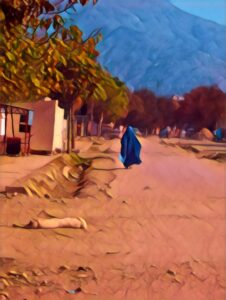
One of the artisans who participated in my first pilot project (2003) in Kabul was a tailoring program student. During our pilot project week together, I learned that Asma* was married with two sons, fourteen and four years old. She’d lost a two-year-old daughter on the arduous trek from Afghanistan to Pakistan, where they fled as refugees following the Taliban takeover. She’d also lost a nephew when her brother’s shop was hit by rocket-fire. When the Taliban fell, she and her family returned to Afghanistan to begin life again. Her husband worked as a shopkeeper but struggled to pay their rent of thirty-two dollars. Ultimately, she discontinued her academic studies and enrolled in tailoring classes to gain a skill to help support the family.
She received a sewing machine as a token of my gratitude for her participation but never returned to the school to collect her complete startup kit, donated as part of our sponsorship program. It included a zigzag machine, a table and chair, an iron, scissors, needles, measuring tape, pattern paper, and fabric for four outfits—enough to help her launch a business. I worried about what might have happened to her to prevent her return.
But when Asma simply stopped attending class one day, Zahra, the school director, made inquiries. So did Tori, my project manager, when she arrived in Afghanistan later that year, in an attempt to give her the startup kit. None of the other tailoring students had any idea where we might find her. It was as if she had fallen off the face of the earth. In a city of 2.5 million people with no phone book, she might as well have.
Four years later, her mysterious disappearance still bothered me. Of course, Zahra couldn’t hold her startup package indefinitely—the needs were so great—so had given it away to another worthy tailoring program graduate.
When I arrived in Kabul for a trip, I wanted to find Asma to see if she was okay. Any leads had grown cold, but a strange thought occurred to me: God knows where she is. His eye is on this sparrow. By now, God was used to my preposterous requests, so I sent another one flying heavenward: Lord, will You help me find Asma on this trip?
Then a friend and I prayed together in Jesus’ name God would help us find her and set out on foot in search of her. The city of Kabul was a chaotic labyrinth with unmapped streets, unnumbered mud houses, shanties, makeshift dwellings with tarp roofs, homes carved from mountain sides, and row after row of grey, Soviet, high-rise apartments. As we went, we asked people we encountered if they knew a lady by the name of Asma, with dark blond hair and blue eyes—unusual coloring for an Afghan woman. Someone had.
We followed the stranger’s directions to a door where we knocked and inquired after Asma. To our amazement, within seconds, she appeared at the door as bewildered as we were. A search that might have taken weeks—and had produced nothing for four years—ended that day, within a matter of hours. I could scarcely take it in.
We joined Asma and the other women of her family for tea, and she explained why she had never returned to Zahra’s school. Shortly after our project concluded, she’d been injured in an accident, when riding on the back of her husband’s motorcycle. She wasn’t physically able to return to class and never even knew more equipment and supplies were waiting for her. Thankfully, she had recovered.
The equipment donated for her was now being used by another woman, if she hadn’t sold it. I considered making up the loss to her by buying her more equipment myself. But with all the interviews and visits I had planned on my brief stint in Kabul, I had no time to traipse through the markets to purchase it myself before departing for Herat. Tori no longer lived here, and Zahra had left the city permanently—there was no one to do it.
I considered just giving her money from my purse. But all the reasons not to ran through my head. That’s not how development is done. You don’t just give people cash. There should be oversight and accountability, especially now that I knew at least one project participant had sold her machine. Besides, how could I be sure her husband wouldn’t confiscate the money?
Leaving Asma’s home, I worshipped El Roi—the God who sees—the Good Shepherd who leaves the ninety-nine to find the one, the God who heard our prayer and led us to her door. We had lost track of Asma, but he never had. He knew her name, her address, and even the number of hairs on her head.
Asma seemed comforted by our presence and touched that we had remembered her. But I have wished many times for a do-over, to be back in her living room so I could hand her cash to buy some sewing equipment for herself. If she used it for another purpose—to buy groceries or pay off a debt—would it really matter? In a lifetime of knee-buckling losses, I could have righted at least one.
Perhaps the God of second chances might still give me—and her—another. In the meantime, will you pray with me that God would shower his blessings on her, most importantly, the blessing of knowing this God who sees her, who has collected all her tears in a bottle.
“You number my wanderings; put my tears into Your bottle; are they not in Your book?” (Psalm 56:8, NKJV)
“Are not five sparrows sold for two pennies? Yet not one of them is forgotten by God. Indeed, the very hairs of your head are all numbered. Don’t be afraid; you are worth more than many sparrows.” (Luke 12:6–7, NIV)
Lord, you amaze me. Forgive me for not asking you to do the seemingly impossible more often, like helping me find one insignificant woman in a city of 2.5 million. She was not insignificant to you. Your eye truly is on the sparrow. Will you provide her and her family every kind of provision they need? Will you let her know how dear she is to you and even give me the chance to reconnect with her again wherever she is in the world? In Jesus’s name, amen.
*Name changed to protect her identity.

Leave a Reply